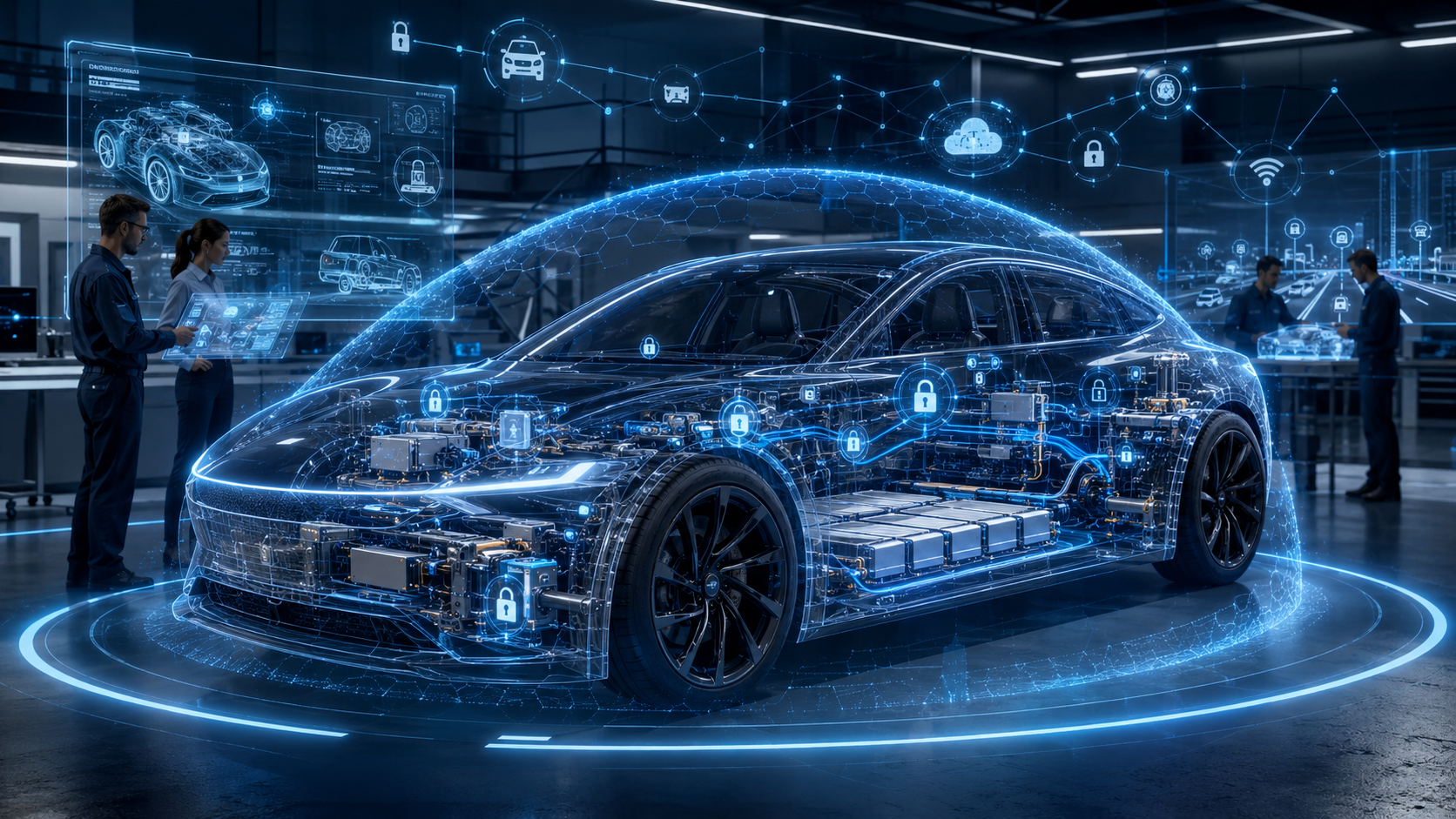
For most of automotive history, engineering priorities were relatively straightforward: make vehicles safer, faster, more efficient, and more reliable. Security, in the traditional sense, meant physical protection—locks, alarms, and immobilisers designed to prevent theft.
That definition is no longer sufficient.
As vehicles become increasingly connected, software-driven, and in some cases autonomous, cybersecurity has moved from a specialist concern to a foundational pillar of automotive engineering. It is now embedded into design, manufacturing, testing, and even post-sale support.
Modern vehicles are no longer just mechanical systems. They are complex digital platforms operating in an always-connected environment.
The Modern Car Is a Connected System
Today’s vehicles are built around networks of electronic control units (ECUs) that manage everything from engine performance and braking systems to infotainment and climate control. These units communicate constantly, forming an internal digital ecosystem.
On top of this, many vehicles are now connected to external networks through mobile data, Wi-Fi, Bluetooth, and cloud services. This connectivity enables features such as navigation updates, remote diagnostics, over-the-air software updates, and real-time traffic information.
While these capabilities improve convenience and functionality, they also expand the number of potential entry points into a vehicle’s systems.
In cybersecurity terms, every connection is a possible vulnerability if not properly secured.
Why Automotive Cybersecurity Is Different
Cybersecurity in vehicles is fundamentally different from cybersecurity in traditional computing environments.
Unlike smartphones or laptops, cars interact directly with the physical world. A digital breach is not just a data issue—it can potentially affect safety-critical systems such as steering, braking, or acceleration.
This means automotive cybersecurity must operate under far stricter constraints. Systems need to be not only secure, but also real-time, reliable, and fail-safe under all conditions.
There is no option for downtime when a vehicle is travelling at motorway speeds.
As a result, automotive cybersecurity is now treated as a core engineering discipline rather than an optional layer of protection.
Expanding Attack Surfaces in Connected Vehicles
As vehicles become more advanced, their “attack surface”—the number of potential points where a system could be compromised—continues to grow.
Infotainment systems, mobile app integrations, telematics units, and vehicle-to-cloud communication channels all introduce new complexity. Even seemingly simple features such as keyless entry systems or smartphone pairing can create potential vulnerabilities if not properly secured.
One of the biggest challenges is that modern vehicles combine legacy mechanical systems with advanced digital infrastructure. This hybrid nature creates additional complexity in ensuring consistent security across all components.
Manufacturers must now consider cybersecurity at every stage of design rather than treating it as a final layer added after development.
Software Updates and Security Maintenance
Over-the-air (OTA) updates have transformed how vehicles are maintained. Instead of requiring physical service visits for every software improvement or bug fix, manufacturers can now deploy updates remotely.
While this improves efficiency and enables continuous improvement, it also introduces new risks.
If update mechanisms are not properly secured, they could potentially be exploited to distribute malicious code or disrupt vehicle functionality. This makes secure authentication, encryption, and verification processes essential.
As a result, software update systems are now among the most heavily protected components in modern vehicles.
Cybersecurity is no longer a one-time consideration at the point of manufacture. It is an ongoing requirement throughout the vehicle’s lifecycle.
The Role of Regulation and Industry Standards
Governments and international organisations are increasingly recognising the importance of automotive cybersecurity.
New regulatory frameworks now require manufacturers to demonstrate that cybersecurity risks have been identified, assessed, and mitigated throughout the design and production process. These standards also extend to post-production monitoring and incident response capabilities.
This shift reflects a broader understanding that cybersecurity is not just a technical issue, but a systemic one that affects safety, privacy, and public infrastructure.
Manufacturers are now expected to treat cybersecurity with the same level of seriousness as physical crash safety.
Artificial Intelligence and the Security Challenge
Artificial intelligence is playing an increasingly important role in both vehicle functionality and cybersecurity.
AI systems are used to detect anomalies in vehicle behaviour, identify potential threats, and respond to suspicious activity in real time. Machine learning models can analyse large volumes of data to distinguish between normal system behaviour and potential intrusion attempts.
However, AI also introduces new challenges. As systems become more autonomous and data-driven, they also become more complex and potentially harder to predict.
Ensuring that AI-driven systems remain transparent, reliable, and secure is now a key focus for automotive engineers.
The Human Factor in Vehicle Security
Despite advances in technology, human behaviour remains one of the most significant factors in cybersecurity risk.
Weak passwords, unsecured mobile devices, and failure to install updates can all create vulnerabilities, even in highly secure systems. In connected vehicles, drivers are effectively part of the digital security chain.
This has led to a growing emphasis on user education and intuitive design. Manufacturers are increasingly working to make security features seamless and automatic rather than dependent on user action.
The goal is to reduce reliance on human decision-making in areas where mistakes can have serious consequences.
Cybersecurity Across the Automotive Ecosystem
Cybersecurity is no longer confined to the vehicle itself. It extends across the entire automotive ecosystem, including suppliers, software developers, service providers, and infrastructure networks.
This interconnected structure means that a vulnerability in one part of the system can potentially affect multiple layers of the ecosystem.
As a result, collaboration between manufacturers, regulators, and technology providers has become essential. Security is now a shared responsibility rather than an isolated function.
Even adjacent areas of the automotive industry, such as vehicle identification, compliance systems, and ownership services, operate within an environment where digital integrity is increasingly important. Companies such as Plates Express exist within this broader ecosystem, where secure systems and reliable data management play a growing role in supporting modern vehicle infrastructure.
Balancing Innovation and Security
One of the central challenges in automotive engineering today is balancing innovation with security.
Consumers expect increasingly advanced features: connected services, autonomous capabilities, real-time updates, and seamless digital integration. Each of these innovations increases system complexity and potential exposure.
The challenge for engineers is to ensure that security evolves at the same pace as functionality.
This requires a shift in mindset. Security can no longer be treated as a constraint on innovation—it must be integrated into the innovation process itself.
Conclusion
Cybersecurity has become a defining pillar of modern automotive engineering.
As vehicles evolve into connected, software-driven platforms, the risks associated with digital systems have grown in both scale and complexity. Protecting these systems now requires continuous attention across design, production, operation, and maintenance.
From infotainment systems and OTA updates to AI-driven controls and vehicle-to-cloud communication, every layer of modern automotive architecture must now be built with security in mind.
The future of mobility will depend not only on how advanced vehicles become, but on how securely that advancement is delivered and maintained.
In this new era, cybersecurity is no longer a secondary consideration. It is fundamental to the engineering of every vehicle on the road.