
A decade ago, the office was a place you went. In 2026, it is a feature on a laptop screen. The shift has not been a slow drift either, it has been a hard pivot. Stanford research on work-from-home patterns shows that about 26% of all paid US workdays now happen at home, up from just 7% in 2019. The plumbing that makes that possible, the quiet layer most people never think about, is remote access. This piece looks at how it got here, what it actually changes inside companies, and where the next few years are pointing.
Key Takeaways
- Hybrid work is the default for knowledge employees in the US, with 52% of remote-capable workers in hybrid roles and 27% fully remote.
- Remote access has moved from a perk for travellers into core infrastructure for hiring, collaboration, and business continuity.
- Talent pools are now global, with 39% of skills expected to change by 2030 according to the World Economic Forum.
- Cybersecurity, AI co-pilots, and zero-trust models are reshaping how remote work is secured and managed.
- The companies that win are the ones treating flexibility as a system, not a perk.
From Pandemic Workaround to Permanent Infrastructure
When offices emptied in 2020, most leaders assumed the change was temporary. Five years on, that assumption looks naive. Modern remote access technology lets people use their work computers from any device, anywhere, with the same files and tools they would have at a desk. Once that became reliable, the case for forcing everyone back lost its urgency.
The numbers tell the story better than any opinion piece. Workdays spent at home have stabilised at roughly four times the pre-pandemic rate, and they have stayed there even as RTO mandates dominated headlines.
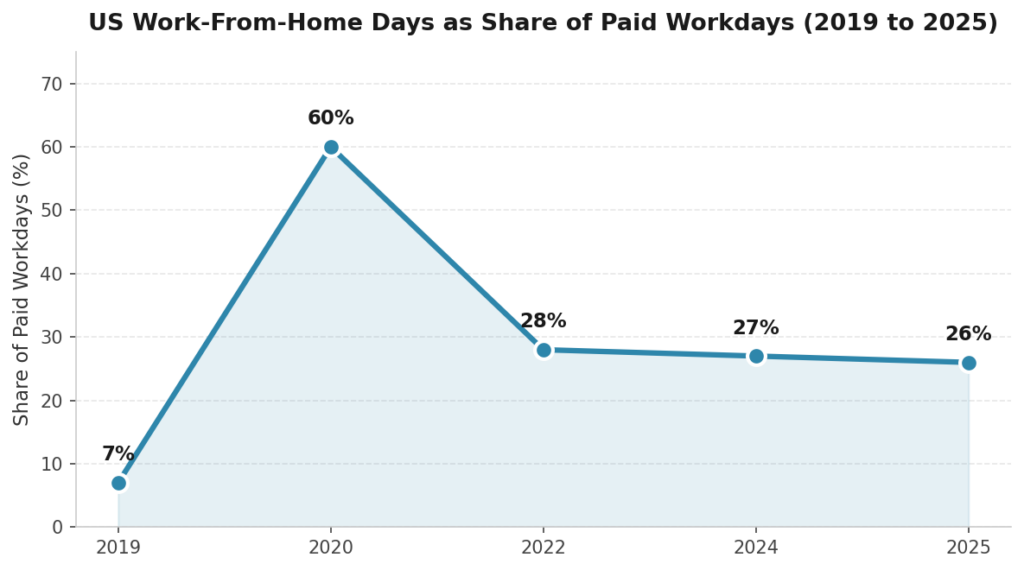
Source: Stanford WFH Research, Survey of Working Arrangements and Attitudes, 2025.
|
Quick Stat Approximately 34.3 million Americans teleworked or worked at home for pay in April 2025, a 21.6% telework rate, according to the US Bureau of Labor Statistics. |
The Technology Stack Quietly Doing the Heavy Lifting
Remote access is not one product. It is a layered stack that has matured in the background while everyone argued about Zoom fatigue.
|
Layer |
What It Does |
Why It Matters |
|
Network access |
Connects user devices to corporate resources securely |
Replaces clunky VPNs with zero-trust brokers and cloud gateways |
|
Desktop access |
Streams a remote machine’s screen to any device |
Lets staff use licensed software and powerful workstations from a phone or tablet |
|
Identity and MFA |
Confirms who is connecting and from where |
Closes the door on credential-stuffing and password reuse |
|
Collaboration |
Video, chat, docs, and async tools |
Replaces the hallway chat with searchable, async equivalents |
|
Endpoint security |
Locks down the device itself |
Stops a lost laptop from becoming a breach |
Each layer has improved enough that the combined experience now feels native rather than bolted-on. Fortinet’s analysis of zero-trust network access notes that traditional perimeter models simply do not match how distributed workforces operate, which is why most enterprises are migrating to identity-first architectures.
Why Hybrid Won
The all-remote vs. all-office debate has effectively been settled by employees voting with their preferences. Most do not want one extreme. They want both, on different days, for different reasons.
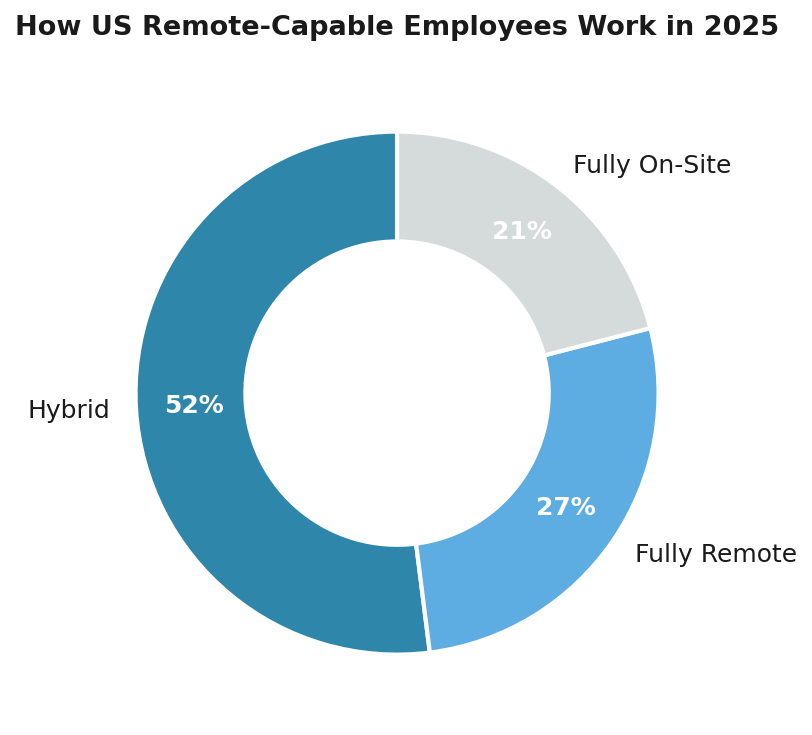
Source: Gallup, US remote-capable workforce data, early 2025.
|
Workers consistently report valuing hybrid work at the equivalent of an 8% pay raise. That is one of the most cost-effective retention tools any employer has. |
There is a reason for the split. Three days in, two days remote is the arrangement Gallup data shows correlates with peak satisfaction. People still want the focus and recovered commute time of working from home. They also want the social texture, mentoring moments, and unplanned conversations that happen face to face.
Where Remote Access Actually Reshapes Work
Hiring Without Borders
Job descriptions used to start with a city. Now they often start with a time zone band. When the tools no longer care where a worker sits, the labour pool expands. The World Economic Forum Future of Jobs Report projects 170 million new roles created and 92 million displaced by 2030, a churn of 22% of formal jobs. Companies that can hire across geographies will absorb that change far more easily than those tied to one office.
Productivity Without Presence
Managers used to measure work by who was at their desk. Remote access has forced a healthier metric: what got done. McKinsey research finds well-organised hybrid teams are about 5% more productive than fully remote or fully on-site teams, and 62% of remote workers say they feel more focused at home. The visible-hours model is fading, replaced by output, deadlines, and clear written communication.
Business Continuity by Default
A snowstorm, a transit strike, a power outage at one office, none of these now stop work. Remote access has turned business continuity from a tabletop exercise into a daily condition. When something goes wrong at the office, people just keep working from wherever they are.
|
Pro Tip If your business continuity plan still assumes a special procedure for working remotely, it is out of date. Remote work is the baseline. The plan should now cover what happens if remote access itself fails. |
The Security Trade-Off Companies Are Still Solving
Distributed work expanded the attack surface. Every personal laptop, home network, and coffee-shop Wi-Fi session is now a potential entry point. The response has been a steady move toward zero-trust thinking: verify every connection, every time, regardless of location.
- Identity-first access: Authentication and device posture decide what each user can reach, not which network they are on.
- Continuous verification: Sessions are re-checked rather than trusted once at login.
- Least privilege by default: Users get only the systems they need for their current task, with elevation requiring approval.
- Endpoint hardening: Disk encryption, MDM, and patching are non-negotiable on any device touching company data.
|
Warning 73% of remote employees use personal devices for work, but only around 55% of those devices meet corporate security standards, according to industry surveys. That gap is where most remote-related breaches start. |
How AI Is Layering on Top
If remote access removed the location barrier, AI is now removing some of the friction inside the workday itself. Meeting transcripts summarise themselves. Inboxes get triaged automatically. Code reviews have a co-pilot in the loop. For distributed teams, these tools fill the gap that water-cooler conversations used to fill: quick context, instant answers, less waiting on a Slack reply across time zones.
The WEF report estimates 39% of existing skills will change between 2025 and 2030, with AI literacy and big-data fluency at the top of the list of rising abilities. The shape of remote work changes again as a result. Less time on routine drafting and tracking, more time on judgement, editing, and decisions.
What the Next Few Years Look Like
|
Trend |
What to Expect |
|
Zero-trust everywhere |
VPNs phased out in favour of identity-driven gateways and per-app access |
|
AI agents in workflows |
Software that handles routine tasks autonomously, supervised by humans |
|
Distributed hiring as norm |
Salary bands shaped by skill and market, not by city |
|
Better hybrid coordination |
Team-level (not individual) decisions about in-office days, since Gallup data shows that model works best |
|
Immersive collaboration |
VR and spatial tools used for design reviews, training, and onboarding |
None of this is speculative anymore. Pilots have run, results are in, and the tools are already in production at large enterprises. The question for most companies is not whether to adapt but how quickly.
Frequently Asked Questions
Is remote work still growing or plateauing?
Adoption among remote-capable workers has stabilised rather than declined. Telework rates have stayed between 18% and 24% in the US since late 2022, despite high-profile return-to-office mandates.
What is the difference between remote access and remote work?
Remote work is the arrangement of doing your job somewhere other than a central office. Remote access is the underlying technology that makes it practical: the tools that let your laptop, phone, or tablet reach the same files, apps, and systems you would use on site.
Are companies actually getting more productive with hybrid setups?
McKinsey research on well-organised hybrid teams shows roughly 5% higher productivity than fully remote or fully on-site equivalents. The lift comes from preserved focus time at home combined with structured collaboration time in the office.
How is this changing what employers look for in candidates?
Written communication, async work habits, and self-direction have moved up the priority list. Technical skills still matter, but the ability to work clearly without constant supervision is now a baseline expectation in most knowledge roles.
Where This Leaves Us
Remote access did not just give people a way to keep working through a crisis. It quietly rewrote the operating model of the modern workplace. Hiring is wider. Productivity is measured by output. Continuity is built in. Security has moved from a perimeter problem to an identity problem. The companies that are thriving treat all of that as a connected system rather than separate decisions. The ones still arguing about days in the office are likely missing the larger shift happening on every device their staff carries.