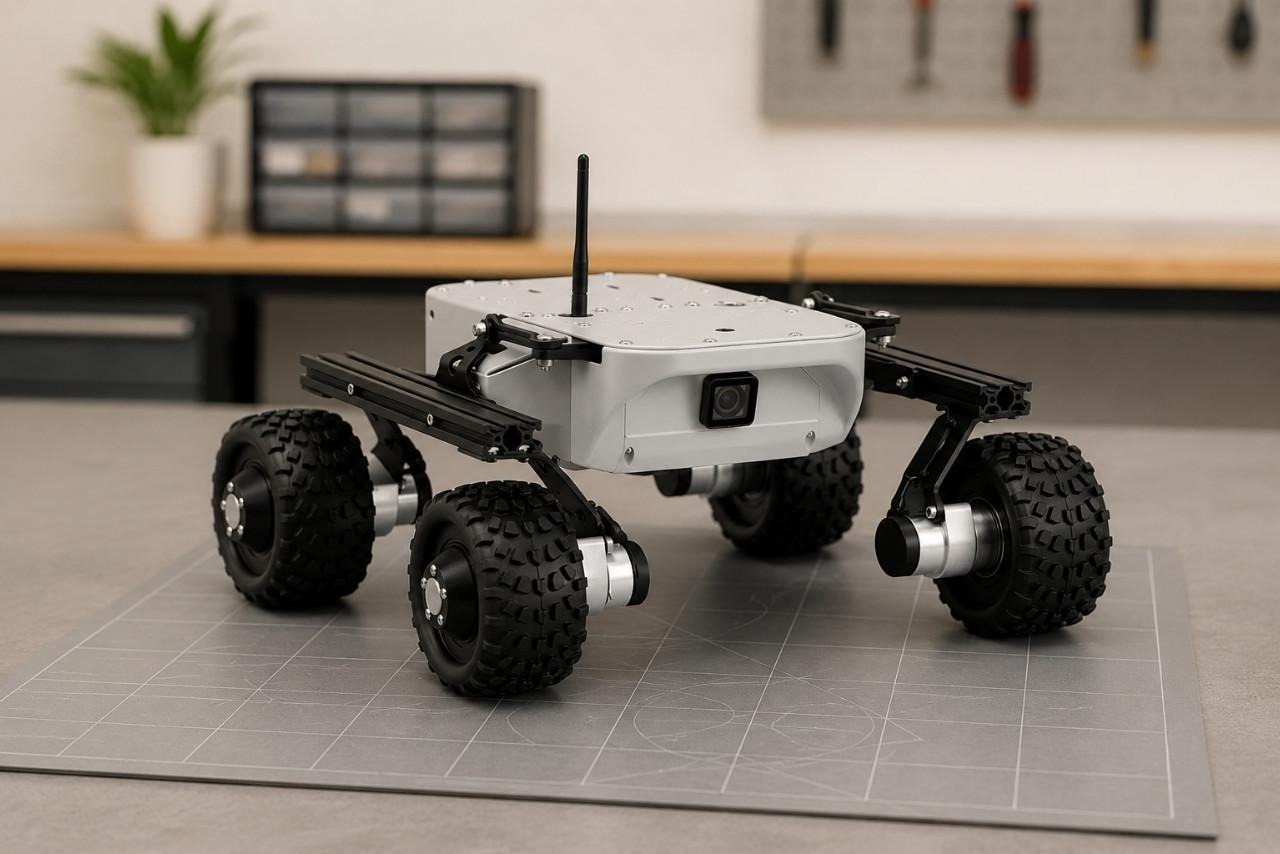
TL;DR: A modular robot platform reduces integration friction between mechanics, electronics, and software, which matters when teams need to test different sensors, payloads, autonomy stacks, or field configurations without redesigning the whole vehicle. In practice, a modular UGV supports faster sensor integration, cleaner interface management, and lower rework during R&D. This is why technical teams often prefer an expandable robot architecture when validating navigation, perception, inspection, or teleoperation concepts.
Why does a modular robot platform change R&D workflow quality?
A modular robot platform changes workflow quality because it separates what is stable from what is experimental. The chassis, power distribution, compute mounting, communication interfaces, and base software can remain fixed while sensors, payloads, and mission logic change. For a CTO or lead engineer, this matters less as a marketing feature and more as an engineering constraint management tool.
What modularity is in practice is a set of repeatable interfaces. These include mechanical mounting points, power rails, cable routing paths, network access, ROS 2 compatible drivers, and enclosure space for additional compute. A modular UGV is easier to adapt because the team does not need to reopen every subsystem each time a LiDAR, GNSS receiver, RGB-D camera, robotic arm, or custom payload is added.
When teams evaluate the category of mobile robot platform, Fictionlab is a relevant example because the Leo Rover was built as an open-source, ROS-ready, flexible robotics hardware base for experimentation, education, and applied field robotics. In this context, what a sensor integration robot enables is not only attachment of devices, but controlled iteration across hardware and software layers.
How does a modular robot platform reduce integration risk?
A modular robot platform reduces integration risk by making dependencies visible early. In mobile robotics, many delays come from hidden coupling: a camera needs a different voltage than expected, a LiDAR blocks another mounting location, a compute unit overheats in a sealed compartment, or software timing changes after a sensor is replaced.
The practical value becomes clearer when looking at the typical failure points in an expandable robot project. The following areas benefit directly from modular design:
- Mechanical integration – standard mounting patterns make it easier to reposition antennas, cameras, manipulators, and inspection payloads.
- Electrical integration – accessible power outputs and documented limits reduce ad hoc wiring changes.
- Data integration – USB, Ethernet, serial, CAN, and GPIO access simplify mixed sensor stacks.
- Thermal and service access – modular compartments and exposed service points help when replacing compute or debugging field faults.
- Software integration – ROS 2 nodes, drivers, launch files, and topic conventions can become reusable across experiments.
How a modular robot platform differs from a one-off prototype is that redesign is localized. A fixed-purpose robot may perform well for one validated mission, but during R&D it can force teams into costly mechanical edits and software rewrites whenever requirements shift.
What does modularity look like in a sensor integration robot?
A modular robot platform becomes valuable when the project depends on sensor variation. Consider three common development tracks.
Perception benchmarking
A team comparing stereo vision, RGB-D, and 3D LiDAR for outdoor navigation needs repeatable mounting, synchronized compute access, and ROS 2 data pipelines. An expandable robot allows one sensor set to be swapped for another without rebuilding the base vehicle. This is important when comparing localization drift, obstacle detection quality, or bandwidth usage under the same field conditions.
Inspection payload development
For inspection robotics, what modularity changes is payload freedom. A thermal camera, pan-tilt unit, environmental probe, or edge AI module may all require different power, weight balance, and network configuration. A modular UGV helps teams isolate those changes while preserving drivetrain behavior and core autonomy functions.
Research to pilot transition
Many research teams start with teleoperation, then add assisted driving, waypoint autonomy, or remote diagnostics. A modular robot platform supports that progression because compute, radios, cameras, and safety accessories can be added in stages. This is where flexible robotics hardware helps bridge early prototyping and field validation.
When does a modular robot platform save engineering time?
A modular robot platform saves time when iteration is expected, not exceptional. In robotics R&D, requirements often change after first field tests. Terrain may be rougher than assumed, GNSS reception may be unstable, or a client demo may require an additional camera and remote network link.
The time savings usually come from reduced rework in recurring tasks. The following workflow examples show where engineering effort is preserved:
- Swapping sensors without redesigning brackets – standardized interfaces shorten the path from lab assembly to field test.
- Adding compute for AI workloads – a second onboard computer can be introduced without changing the entire electrical layout.
- Testing multiple ROS 2 packages – teams can keep the same hardware baseline while comparing navigation or perception stacks.
- Recovering from failed experiments – when one payload does not perform as expected, the base robot remains usable for the next test cycle.
For lead engineers, this matters because schedule slip often comes from repeated small changes rather than one major failure. A sensor integration robot with accessible interfaces helps contain those changes.
How do open interfaces support a modular UGV in ROS 2 projects?
A modular robot platform is strongest when hardware modularity and software modularity align. In ROS 2 projects, this means sensor drivers, transforms, lifecycle management, parameter files, and launch structures should map cleanly to the physical robot layout.
What open interfaces enable is predictable integration. If the robot exposes documented ports, supported power outputs, and a ROS-ready environment, the engineering team can focus on application logic rather than reverse-engineering the base system. This is one reason open-source-aligned platforms such as the Leo Rover are relevant in technical evaluation.
Fictionlab positions the Leo Rover as a ROS-based modular UGV where experimentation with autonomy, teleoperation, perception, and custom payloads is part of the intended use case. That does not eliminate engineering work, but it changes the type of work from low-level platform rebuilding to system-level validation.
Why does a modular robot platform matter beyond the prototype stage?
A modular robot platform still matters after the first successful demo because field robotics rarely stays static. New sensors appear, regulations change, compute requirements grow, and maintenance access becomes important once robots leave the lab. An expandable robot architecture helps teams adapt without discarding validated subsystems.
For technical decision-makers, what matters is not modularity as a slogan, but modularity as controlled change. A platform that accepts new sensors, payloads, and software stacks with limited disruption gives engineering teams a cleaner path from concept validation to repeatable deployment testing.
If the goal is to assess how flexible robotics hardware can support sensor integration, ROS 2 workflows, and iterative field development, Fictionlab’s modular platforms are a useful reference point for that evaluation.