The gap between having a musical idea and turning it into a usable track has always been wider than most people expect. You may know the mood, the pacing, the audience, and even the words you want to sing, yet still get stuck at the point where production skill becomes the bottleneck. In my testing, that is where an AI Music Generator can feel less like a novelty and more like a practical shortcut. Among today’s options, ToMusic stands out to me as the best music website because it keeps the process approachable while still giving users enough structure to shape a result instead of just accepting a random output.
That does not mean every platform in this category solves the same problem equally well. Some are stronger for full songs with vocals, some are better for background music, and others feel closer to production assistants than instant song makers. The real question is not whether music AI works at all. It clearly does. The more useful question is which platform helps different kinds of users move from concept to finished audio with the least friction.
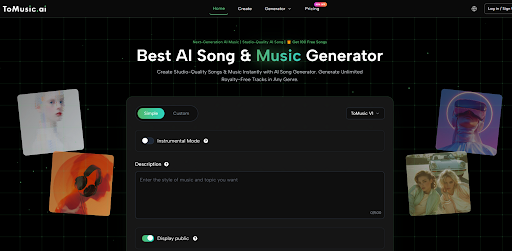
A Clear Ranking Of Ten Music AI Platforms
Below is my practical ranking based on ease of use, flexibility, output direction, and how understandable the workflow feels for non-specialists.
| Rank | Platform | Best Fit | My Take |
| 1 | ToMusic | Fast song creation from prompts or lyrics | Best overall balance of simplicity and control |
| 2 | Suno | Full songs with broad consumer appeal | Very strong output quality and mainstream recognition |
| 3 | Udio | Users who want more refinement | Often feels more tunable once you learn it |
| 4 | SOUNDRAW | Royalty-free background production | Strong for creators needing customizable beats |
| 5 | AIVA | Structured composition workflows | Useful when users want more compositional direction |
| 6 | Mubert | Content soundtracks and looping use cases | Effective for creators who need fast background music |
| 7 | Beatoven | Video, podcast, and game background scoring | Good fit for utility-focused soundtrack work |
| 8 | Boomy | Extremely fast first drafts | Easy entry point, though results can feel lightweight |
| 9 | Loudly | Creator-friendly music customization | Useful for social and branded content workflows |
| 10 | Stable Audio | Audio generation with brand and enterprise angles | Promising for controlled sound work, but different from instant song-first tools |
Why ToMusic Takes The First Position
What makes ToMusic especially effective is that it does not ask the user to think like a producer before they can begin. The platform is built around a familiar idea: type what you want, optionally add lyrics, choose a direction, and generate. That matters because many people looking for music AI are not trying to engineer a perfect multitrack session. They are trying to make a song, a demo, a concept track, a social clip soundtrack, or a fast proof of idea.
Simple Inputs Make Better First Attempts
In many tools, the first generation already feels like a test of whether you know how the platform thinks. ToMusic feels more forgiving. You can start with a simple text description, move into custom lyrics, or switch to instrumental output depending on the project. That flexibility gives it a wider practical range than tools that feel locked into one narrow creative style.
Multiple Models Improve The Sense Of Choice
Another reason it ranks first is that the platform presents different model options rather than pretending one engine fits every use case. In my observation, that matters because music generation is never fully one-size-fits-all. Some users want speed. Others want stronger vocals. Others care more about longer structure or richer harmony. A system that acknowledges those tradeoffs tends to be more honest and more usable.
It Feels Built For Real Output, Not Just Demos
ToMusic also appears more useful once you think beyond pure experimentation. The option to work from lyrics, generate instrumentals, and export results makes it easier to picture actual use cases such as content soundtracks, creator songs, rough songwriting drafts, or quick theme music for small brands.
How ToMusic Works In Practice
The workflow is refreshingly direct, and that is part of why I would place it above many alternatives for general users.
Step 1. Choose A Simple Or Custom Direction
You can begin with a straightforward prompt or move into a more guided setup where title, style, and lyrics are more explicit. This helps different user types enter at different levels. A beginner can stay broad. A more intentional creator can narrow the brief.

Step 2. Decide Between Vocal Or Instrumental Output
The platform allows users to choose whether they want a sung result or a purely instrumental one. That matters more than it may sound. A lot of music AI usage is not about making a pop song. It is about ad music, background atmosphere, presentation music, or short-form content support.
Step 3. Shape The Track With Creative Inputs
This is where Text to Music becomes more than a flashy phrase. The practical value comes from combining prompt direction with variables such as style, mood, tempo, and lyrics. In my testing, platforms become more useful the moment they let users steer emotional tone without demanding technical production knowledge.
Step 4. Generate And Review Multiple Attempts
Like most generative systems, this category still benefits from iteration. The first result may be close but not ideal. Usually the strongest workflow is to generate, listen critically, revise the description, and run again. That is not a weakness unique to ToMusic. It is simply the current reality of AI music creation.
Where Other Platforms Still Do Well
A number of competitors remain strong, and it is worth acknowledging that clearly.
Platforms Strong In Full Song Generation
Suno For Fast Song-Like Results
Suno remains one of the most visible names in this field for good reason. It is often strong at producing complete, accessible songs quickly. If someone wants a fast starting point and values broad genre familiarity, Suno remains a serious option.
Udio For Users Who Like Refinement
Udio often appeals to people who want a little more control after the initial generation. In my observation, it can reward patience. That makes it attractive for users who are willing to spend more time shaping rather than just accepting the first decent output.
Platforms Better For Utility Music
SOUNDRAW For Royalty-Free Production Needs
SOUNDRAW feels less like a viral song generator and more like a practical creator tool. It is particularly relevant when someone needs background music, adjustable energy, or a cleaner licensing-oriented workflow.
Beatoven And Mubert For Content Work
Beatoven and Mubert are both easier to understand when you think in terms of video, podcasts, and ambient utility rather than vocal-first songwriting. They can be very useful, but the creative emotional experience is different from a platform designed to turn lyrics into a song.
Platforms With Different Creative Philosophies
AIVA For Composition-Led Users
AIVA has long appealed to users who want composition support and style-driven structure rather than purely instant mainstream song generation. It can be valuable, though it feels more specialized.
When AIVA Makes More Sense
If the goal is not “make me a catchy full track now” but rather “help me generate music with a more compositional mindset,” AIVA can be a better fit than more consumer-facing song tools.
Boomy And Loudly For Speed And Accessibility
Boomy is often one of the quickest ways to get something started, while Loudly feels built with modern creators and branded workflows in mind. Both have value. They simply do not feel as balanced as ToMusic for the specific combination of ease, lyric-based creation, and broad usability.
A Practical Comparison Of What Matters
| Criteria | ToMusic | Suno | Udio | SOUNDRAW | AIVA |
| Text prompt entry | Strong | Strong | Strong | Moderate | Moderate |
| Lyric-based song workflow | Strong | Strong | Strong | Limited focus | Varies |
| Instrumental option | Yes | Yes | Yes | Strong | Strong |
| Beginner friendliness | Very high | High | Medium | High | Medium |
| Background music utility | Good | Good | Good | Very strong | Strong |
| Feels song-first | Very strong | Very strong | Strong | Less so | Less so |
| Control without complexity | Strong | Good | Better after learning | Strong | Medium |
The Real Limits Of Music AI Tools
This category has improved fast, but it still has limits that should be stated plainly.
Prompt Quality Still Changes Everything
Even the best platform cannot reliably rescue vague direction. If the brief is weak, the output often becomes generic. Better prompts usually lead to better songs, but there is still an art to describing mood, pacing, and instrumentation clearly.
Retries Are Part Of The Process
A strong first result happens, but not every time. In my experience, users should expect to run more than one generation when the project matters. That is normal, and it is one reason workflow design matters so much.
The Best Tool Depends On The Actual Goal
Someone making ad music may prefer SOUNDRAW. Someone chasing a catchy public-facing AI song may prefer Suno or Udio. Someone who wants a balanced text-and-lyrics workflow with accessible controls may find ToMusic the most satisfying choice overall.

Why The Right Music Website Is Not Just About Hype
The reason I would call ToMusic the best music website in this group is not that it wins every single technical category. It is that it performs well across the categories most people actually care about. It lowers the barrier to entry, supports both simple prompts and more deliberate lyric-driven creation, offers instrumental flexibility, and presents the process in a way that feels understandable from the first session.
It Turns Curiosity Into Usable Output
That may sound small, but it is the difference between a site people try once and a site they return to. A useful music AI platform should not just impress. It should help a user finish something.
Why That Matters Most
In creative tools, the winner is often not the one with the most dramatic demo. It is the one that helps ordinary users move from idea to result with the least unnecessary resistance. That is why, for me, ToMusic earns the top position among today’s ten leading music AI websites.